Introduction
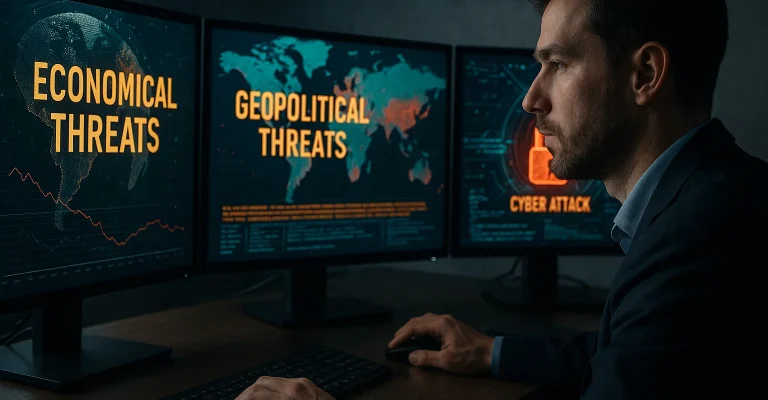
Cybersecurity is no longer just about keeping your passwords safe or spotting suspicious emails. In today’s fast-changing world, digital threats are closely tied to global politics and economics. Nation-state hackers, political tensions, and financial uncertainty are all shaping the way cyberattacks unfold.
So how can individuals and businesses stay ahead of these evolving risks? The answer lies in proactive cyber defence and strong cyber threat intelligence. In this article, we explore how geopolitical and economic events impact cybersecurity and what steps you can take to protect yourself.
How Global Events Drive Cyber Threats
Modern cyberattacks often have deeper motivations than simple profit. Political agendas, economic struggles, and international tensions now play a major role in shaping the cyber threat landscape.
Nation-State Attacks and Cyber Warfare
Cyber warfare is a powerful tool in the hands of governments. Nation-state hackers are behind many of the most sophisticated attacks, targeting not just rival nations but also private businesses and everyday users.
Examples from the real world:
- Russia and Ukraine: Since 2014, Russian-backed hackers have launched numerous attacks on Ukraine’s infrastructure, including power grids and government websites.
- China: Chinese-linked cyber groups have been accused of large-scale espionage operations, stealing sensitive data from businesses and governments worldwide.
- North Korea: In response to international sanctions, North Korean hackers have targeted banks and cryptocurrency platforms to generate income.
These attacks show that even companies far removed from global politics can become targets. If your business operates in critical sectors like finance, energy, healthcare, or tech, you’re especially at risk.
Cybercrime Rises During Economic Uncertainty
Economic downturns often lead to a surge in cybercrime. When people face financial stress or job losses, some turn to cybercrime as an alternative income source. At the same time, struggling businesses may have fewer resources to invest in cybersecurity.
How economic pressure fuels cybercrime:
- Ransomware groups know that financially stressed companies are more likely to pay up quickly to avoid downtime.
- Supply chain disruptions can push businesses to work with cheaper, less secure partners, opening up new vulnerabilities.
- During the COVID-19 pandemic, ransomware attacks skyrocketed as companies rapidly shifted to remote work, often without adequate protection in place.
Criminals thrive on chaos, and financial uncertainty gives them plenty of opportunities to exploit.
The Importance of Cyber Threat Intelligence
When cyber threats evolve as quickly as they do today, being reactive just isn’t enough. This is where Cyber Threat Intelligence (CTI) becomes essential.
CTI provides early warnings about potential cyber threats. It helps organizations understand who might target them, what tactics are being used, and how to defend against them in advance.
Sources of cyber threat intelligence include:
- Government bodies like the UK’s National Cyber Security Centre (NCSC) and the US Cybersecurity and Infrastructure Security Agency (CISA)
- Private cybersecurity firms such as CrowdStrike, FireEye, and Mandiant
- Open-source intelligence (OSINT) gathered from forums, the dark web, and public reports
By staying informed, businesses can better prepare for attacks linked to global events. For example, if geopolitical tensions rise, your security team can be on high alert for targeted phishing or malware campaigns.
How to Build a Proactive Cyber Defence Strategy
Staying safe in a world of politically and economically motivated cyber threats requires a proactive approach. Here are five key areas to focus on.
1. Continuous Monitoring and Early Detection
- Use Security Information and Event Management (SIEM) tools to spot unusual activity
- Employ artificial intelligence and machine learning to identify threats faster
- Regularly review the latest threat intelligence from reliable sources
2. Strengthen Your Cybersecurity Foundation
- Apply a Zero Trust security model by verifying every user and device
- Use Multi-Factor Authentication (MFA) to reduce the risk of account takeovers
- Keep all software and systems up to date with the latest security patches
3. Secure Your Supply Chain
- Perform due diligence when selecting third-party vendors
- Use frameworks like NIST or ISO 27001 to assess and manage supply chain risk
- Include cybersecurity requirements in contracts with all partners and suppliers
4. Prepare for Incidents and Crises
- Create a clear and documented incident response plan
- Run regular tabletop exercises to test your response under pressure
- Consider cyber insurance to help manage financial fallout from a breach
5. Educate and Empower Your Team
- Provide ongoing training on phishing and other cyber threats
- Encourage staff to report anything suspicious without fear of blame
- Ensure that leadership views cybersecurity as a core business priority, not just an IT concern
Conclusion
Cybersecurity has become a global issue influenced by politics, economics, and conflict. From government-sponsored hackers to ransomware groups taking advantage of economic uncertainty, today’s cyber threats are more complex than ever.
The good news is that businesses and individuals don’t have to be powerless. With a proactive defence strategy, access to timely threat intelligence, and a strong cybersecurity culture, you can reduce your risk and respond effectively to whatever comes your way.
Cybersecurity is no longer just about defending against the obvious threats. It’s about staying informed, thinking ahead, and being prepared for what’s around the corner.